



September 2026 Housing Market by the Numbers: King & Snohomish County
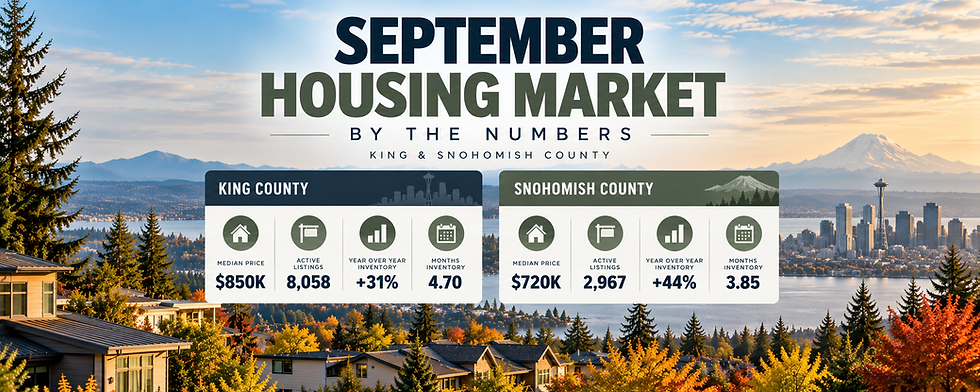
September gave Seattle-area homebuyers something that has been scarce for much of the past decade: a genuinely larger selection of homes to choose from.
King County finished the month with 8,058 active residential and condominium listings, 31.1% more than a year ago. Snohomish County's inventory grew even faster, climbing 44.2% to 2,967 active listings. At the same time, fewer buyers were putting homes under contract, and closed sales declined in both counties. Yet prices barely moved. King County's median sale price remained exactly $850,000, while Snohomish County's $720,000 median was down only 0.4% from September 2025.
That combination is the central story of the September market. Buyers have considerably more leverage than they did when inventory was scarce, but this has not translated into a broad collapse in home values. Instead, King and Snohomish Counties are moving through a slower, more selective market where buyers can compare competing listings and sellers have less room for mistakes.
September 2026 at a Glance
King County ended September with:
$850,000 median sale price
8,058 active listings
2,072 pending sales
1,714 closed sales
4.70 months of inventory
Active inventory up 31.1% year over year
Pending sales down 16.7%
Closed sales down 12.2%
Snohomish County ended September with:
$720,000 median sale price
2,967 active listings
819 pending sales
771 closed sales
3.85 months of inventory
Active inventory up 44.2% year over year
Pending sales down 17.0%
Closed sales down 8.9%
Those figures include residential homes and condominiums. Looking specifically at single-family homes, September's median was $949,975 in King County and $750,000 in Snohomish County. King County's single-family median was down less than 1% from a year earlier, while Snohomish County's was unchanged.
Inventory Is Now the Biggest Change in the Market
If you only watched home prices, it would be easy to miss how different the Seattle-area market has become.
King County's 31.1% year-over-year increase means buyers had roughly one-third more active homes and condos to consider than they did last September. In Snohomish County, the increase was more than 44%. That was one of the largest inventory increases anywhere in the 27-county Northwest MLS service area. Across the full NWMLS region, 24,965 properties were available at the end of September, the highest September inventory level since 2014.
We were already seeing this trend heading into the month. In our Seattle-Area Housing Market: What to Expect in October 2026, August inventory was running 22% above the previous year across the broader NWMLS region. September did not reverse that trend. Supply continued building, particularly in King and Snohomish Counties, giving buyers considerably more alternatives than they had in the inventory-starved markets of recent years.
Buyer Activity Slowed at the Same Time
More homes for sale would matter less if buyers were absorbing that new inventory at the same pace. They are not.
King County recorded 2,072 pending sales in September, down 16.7% from a year earlier, while its 1,714 completed sales represented a 12.2% decline. Snohomish County followed almost the same pattern: 819 pending sales were down 17%, while 771 closed transactions were 8.9% below September 2025. Across the entire Northwest MLS service area, pending sales fell 15.1%, the sharpest year-over-year decline of 2026 to date.
That does not mean buyers have disappeared. Thousands of homes are still going under contract and closing every month. What has changed is the relationship between supply and demand. A buyer who sees a house in Shoreline, Kenmore or Bothell may have several reasonable alternatives to compare before making an offer. That ability to compare condition, location and price is one of the reasons homes can still sell well while the overall market feels noticeably less frantic.
Prices Are Proving Much Stickier Than Inventory
With inventory climbing this quickly and pending sales falling, it might seem logical that prices would be dropping at the same pace. So far, they are not.
King County's combined residential and condominium median was $850,000 in September — exactly where it stood one year earlier. Snohomish County's median moved from roughly $723,000 to $720,000, a decline of only 0.4%. The same pattern appears in single-family housing, where King County's $949,975 median was down less than 1% and Snohomish County remained at $750,000.
This is a good example of why inventory and sales activity often tell us more about a changing market than one month's median price. Sellers do not always respond to weaker demand by immediately cutting prices. Some reduce their asking price, some negotiate, some simply wait longer, and others decide not to sell at all. Meanwhile, the mix of properties closing in any particular month can move the median independently of what an individual home's value is doing.
Months of Inventory Shows How Much the Balance Has Shifted
King County reached 4.70 months of inventory in September, up from 3.2 months one year earlier. Snohomish County rose from 2.4 months to 3.85 months. Across the entire Northwest MLS system, the figure reached 4.44 months, compared with 3.25 months in September 2025.
That is a substantial change from the exceptionally tight markets Seattle-area homeowners became accustomed to. It does not mean every neighborhood has become a buyer's market, and countywide averages can hide dramatic differences between property types and price ranges. A well-priced detached home in a sought-after neighborhood can still attract immediate interest, while a condo or an aggressively priced listing may face a much larger pool of competition. The important shift is that buyers generally have enough selection to be more discriminating.
The Countywide Numbers Hide Very Different Local Markets
A county as large and diverse as King should never be treated as one housing market. The $850,000 median combines Seattle condos, Eastside luxury homes, older houses in North King County, new construction, waterfront properties and dozens of smaller submarkets. Snohomish County has the same issue, stretching from urban areas around Lynnwood and Mountlake Terrace to considerably different markets farther north and east.
Our recent Kenmore Housing Market Update is a good example. Kenmore finished September with 164 active listings, 37.4% more than a year earlier, while the median sale price was $912,000. Buyers clearly had more choices, yet homes that did sell were still closing at roughly their asking price on average. In Shoreline's recent market update, we saw the same broader theme developing: more inventory and greater buyer selectivity without desirable homes suddenly becoming impossible to sell.
That is why a countywide report is useful for identifying the direction of the market, but it should not be treated as a valuation tool for an individual property.
What September Means for Buyers
For buyers, the clearest advantage is choice.
More inventory means there is less pressure to overlook problems simply because nothing else is available. Buyers can compare a home's condition, updates, commute, neighborhood, HOA costs or lot characteristics against other listings before deciding what represents good value. Listings that have been sitting on the market may also give buyers more room to negotiate price, inspection terms, closing costs or other concessions than they would have had in a tighter market.
The other side of that equation is affordability. More negotiating leverage does not automatically make Seattle-area housing inexpensive, and a median price of $850,000 in King County still puts substantial pressure on monthly payments. Buyers who have been waiting for a dramatic decline in prices have so far seen a different adjustment: considerably more inventory and slower competition, but relatively stable closed-sale prices.
What September Means for Sellers
For sellers, this is increasingly a market where the competition matters as much as the most recent comparable sale.
A home may have been worth a certain price based on spring sales, but if several similar houses are now available nearby, buyers can compare them side by side. That makes pricing, condition, photography, staging and presentation more important. An ambitious asking price that might have attracted an offer quickly when inventory was scarce can now result in a listing sitting while buyers pursue better-positioned alternatives.
That does not mean sellers need to panic or price every property below market. September's relatively stable median prices show that buyers are still willing to pay for homes they perceive as good values. The challenge is making sure the property competes well from the beginning rather than relying on a market that automatically pushes buyers through the door.
The Shift Is Easier to See When You Look Back a Few Months
The current market did not change overnight.
Our September 2026 Real Estate Market Update, which covered August activity, was already showing significantly higher inventory in both counties. King County single-family inventory was roughly 30% higher than the previous year, and Snohomish County was up about 33%. September pushed the broader residential-and-condo inventory increases to 31% and 44%, respectively.
That progression matters. One month can be noisy, particularly when looking at smaller cities. Several consecutive months of rising inventory and softer sales activity are much harder to dismiss as a statistical quirk.
For homeowners who prefer to follow the market visually, Chris also publishes regular local market-report videos covering King County, Snohomish County and individual North End communities. You can find the latest reports on the Chris Byler Real Estate YouTube channel.
Is This Finally a Buyer's Market?
That depends heavily on where and what you are buying.
King County's 4.70 months of inventory represents a much more balanced environment than the extremely supply-constrained markets of recent years, while Snohomish County's 3.85 months remains somewhat tighter. But neither county behaves uniformly. Condos can have considerably more inventory than detached homes, and individual neighborhoods can remain competitive even when countywide statistics appear soft.
Rather than trying to attach one label to the entire region, September is better understood as a market with increased buyer leverage. Buyers generally have more time, more alternatives and more ability to reject an overpriced or poorly prepared home. Sellers can still achieve strong results, but fewer of them can rely on scarcity to compensate for pricing or condition.
What to Watch Going Into Late Fall
The next question is whether inventory starts declining normally as sellers pull homes from the market for winter, or whether a larger-than-usual number of listings carries into November and December.
Buyer activity will matter just as much. September produced 9,996 new listings across the Northwest MLS region but only 6,231 pending sales. In other words, roughly 62 homes went under contract for every 100 new listings entering the market, compared with about 80 for every 100 a year earlier. If that gap persists, buyers could continue to have unusually strong selection even as the normal fall slowdown reduces new inventory.
That is the trend we will be watching closely through the rest of October. The Seattle-area market is not experiencing a dramatic price correction, but the balance between buyers and sellers has changed substantially.
The Bottom Line
September's numbers tell a more nuanced story than either “the market is crashing” or “nothing has changed.”
A lot has changed.
King County inventory is up 31%. Snohomish County inventory is up 44%. Pending sales are down about 17% in both counties. Months of inventory are approaching four to five months. Buyers have more homes to compare and more reason to be selective.
At the same time, King County's median price is exactly where it was a year ago, and Snohomish County's is down less than half of 1%.
That is what the Seattle-area housing market looks like entering the heart of fall 2026: more supply, less urgency and considerably more competition between sellers, but prices that have so far proven resilient.
For more local housing-market reports, homeowner information and neighborhood coverage, visit the North End Homes blog. If you are considering buying or selling in North King County, South Snohomish County, North Seattle or the Eastside, Chris Byler at Windermere Real Estate can help you look beyond the countywide averages and understand the competition around a specific home.


Comments