



Selling a Home With a Shared Driveway or Easement in Washington
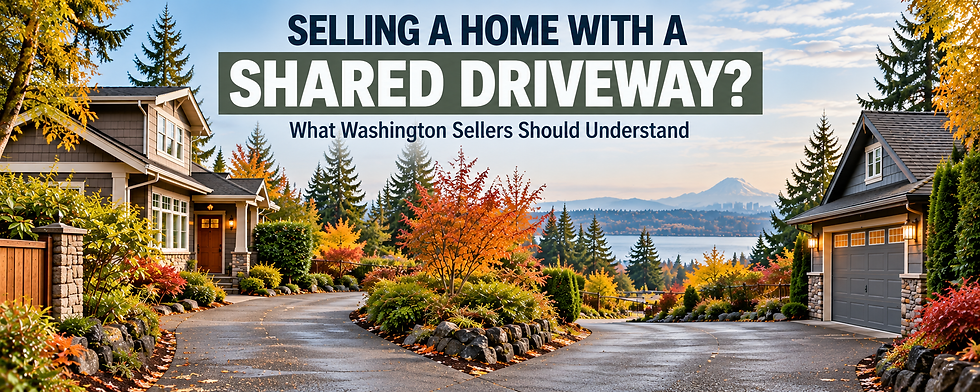
A shared driveway can be so ordinary that homeowners barely think about it. Two neighbors use the same paved entrance, everyone knows where to park, somebody calls the paving company when the asphalt gets rough, and the arrangement may work for decades without much discussion.
Then one of the homes goes up for sale.
Suddenly, buyers want to know exactly who owns the driveway, who has the legal right to use it, who pays for repairs, whether anyone can park in the shared portion, and what happens if the neighbors disagree. In older neighborhoods around Seattle, Shoreline, Lake Forest Park, Kenmore, Bothell and much of King and Snohomish Counties, those questions can be complicated by lot splits, older easements and driveway arrangements that may have evolved informally over time.
A shared driveway is not automatically a problem for a sale. In many cases, it is simply part of the property. What tends to make buyers nervous is uncertainty.
Start by Figuring Out What You Actually Have
“Shared driveway” is a useful everyday description, but it does not tell you what the legal arrangement is. One property may own the entire driveway while the neighbor has an easement allowing access across it. The driveway may physically cross both parcels. Several homes may use a private road under a recorded easement. In other cases, the neighbors may simply have used the same space for years without anyone having a clear document explaining the arrangement.
That distinction matters when you sell. Before trying to explain the driveway to buyers, find out how the property is actually titled and what recorded documents affect it. A preliminary title report is a good starting point because it generally identifies recorded easements, rights-of-way and other exceptions affecting the property. From there, the underlying recorded easement can be reviewed to see what rights it actually grants. This is one of those issues where early preparation can prevent a relatively ordinary property feature from becoming a last-minute transaction problem. We have talked about the same principle more broadly in How the Right Listing Preparation Can Reduce Stress When Selling Your Home.
Read the Easement, Not Just the Title Report
Seeing the word “easement” on a title report is only the beginning. The actual document may describe where the easement runs, which parcels benefit from it, what the access can be used for and whether there are restrictions on parking, gates, improvements or maintenance.
For example, an easement allowing a neighboring property to use a driveway for ingress and egress does not necessarily mean that neighbor can treat the entire area as additional parking. Likewise, an easement may cover only a specific strip of land rather than every paved area people have become accustomed to using. Some documents are very detailed; others are decades old and surprisingly vague. If the language is unclear or the current use appears inconsistent with the recorded document, that is a good point to involve a Washington real estate attorney rather than trying to interpret property rights from the driveway itself.
Compare the Paperwork With What Happens in Real Life
Once you know what the recorded documents say, look at how the driveway is actually used. That comparison is often where the important questions appear. Maybe the easement is 12 feet wide, but the paved area has gradually expanded. Maybe a neighbor routinely parks along one side even though the document appears to grant passage only. Perhaps both owners have always split repair bills even though there is no written maintenance agreement, or one owner has maintained everything for years without asking the other to contribute.
None of those situations automatically means there is a legal dispute. Neighbors frequently develop practical arrangements that work perfectly well. The issue for a seller is whether a buyer will understand what rights are being transferred with the property. A buyer is not stepping into decades of personal history between two neighbors; they are buying the rights and obligations attached to the real estate. The clearer that distinction is before listing, the easier it is to explain the property accurately.
Who Pays to Maintain a Shared Driveway?
The cleanest answer is whatever the recorded easement or maintenance agreement says. A good agreement may specify how paving, gravel, drainage, vegetation, snow removal and larger repairs are divided. It may split costs evenly, allocate them according to use, or create another formula appropriate for the properties involved.
When there is no written maintenance agreement, the answer can become more complicated. Washington courts have recognized circumstances where users of a shared private road or easement may be required to contribute an equitable share of reasonable maintenance expenses, but the result depends on the easement language and the facts of the particular arrangement. That is why sellers should be cautious about casually promising a buyer that expenses are “always 50/50” just because that is how the neighbors have historically handled them.
If there is already a written maintenance agreement, gather it before listing. If there is not one, that does not automatically mean you need to create one, but an unclear arrangement involving significant recurring costs may deserve closer attention before the property reaches the market.
What if the Neighbor Has Been Using the Driveway Without a Recorded Easement?
This is where an informal arrangement can become more legally significant. Washington recognizes prescriptive easements, which can arise when someone uses another person's property in a qualifying manner for a long enough period. The general prescriptive period is 10 years, but time alone is not enough. Washington courts look at factors including whether the use was open, continuous and adverse rather than permissive.
That last point is important. A neighbor using part of a driveway for 15 years does not automatically mean they now own an easement. If the use occurred with permission, the legal analysis can be very different. Because these disputes are highly fact-specific, a seller who discovers long-term use that does not match the recorded documents should get legal advice rather than assuming either that the neighbor has no rights or that an easement has automatically been created.
The important practical point is simpler: if the title documents say one thing and decades of use suggest something else, understand the discrepancy before putting the home under contract.
When a Survey Can Be Worthwhile
Many shared-driveway questions are really boundary questions in disguise. The pavement may look centered between two homes while the actual property line sits several feet to one side. A retaining wall, fence, garage or landscaping may also make it difficult to tell where one parcel ends and another begins.
A seller does not need to order a new survey every time a driveway is shared. But if the location of the property line matters to how the driveway functions, if improvements appear close to or across the line, or if the neighbors disagree about ownership, a survey may provide information that visual inspection cannot. The goal is not to create unnecessary pre-listing expenses; it is to resolve questions that are likely to matter to a buyer.
Washington's Seller Disclosure Form Specifically Addresses Easements
Washington's residential seller disclosure form asks directly about several issues that can apply to shared driveways. Sellers are asked whether there is a private road or easement agreement for access to the property, whether rights-of-way, easements or access limitations may affect the buyer's use of the property, and whether there are written agreements for joint maintenance of an easement or right-of-way.
The form is based on the seller's actual knowledge, which is an important distinction. Sellers should answer accurately rather than guessing at legal conclusions. If you know an easement exists, disclose it appropriately and provide relevant documents where called for. If there is a boundary dispute, maintenance disagreement or another known issue, that may require additional treatment. Questions about how a particular situation should be disclosed are worth discussing with your broker and, when the issue becomes legal rather than factual, a real estate attorney.
We recently looked at a similar distinction in Selling a Home With Unpermitted Work in Washington. In both situations, buyers can often evaluate a known condition more easily than a vague problem nobody can clearly explain.
Buyers Usually Care More About Certainty Than the Shared Driveway Itself
A buyer evaluating a shared driveway is usually trying to answer practical questions. Can I reliably get to my house? Can the neighbor block my access? Where can I park? Who pays when the driveway needs to be resurfaced? Can I widen it, install a gate or change the landscaping? Has there ever been a disagreement?
Those are reasonable questions, and clear documentation makes them much easier to answer. A recorded easement, a straightforward maintenance history and a good relationship between the properties can make a shared driveway feel routine. An unexplained arrangement, conflicting stories and missing documents can make the same physical driveway feel risky. It is the same reason good listing preparation is about more than cosmetics. As we discussed in What “Market-Ready” Really Means Before Listing Your Home, preparation should also consider the issues that could cause a buyer to hesitate once they start looking closely at the property.
This Matters More in a Market Where Buyers Have Choices
The Seattle-area market in fall 2026 gives buyers substantially more inventory to compare than they had during the tightest recent years. As we covered in Seattle-Area Housing Market: What to Expect in October 2026, active inventory across the Northwest MLS service area was 22% higher year over year at the end of August, while pending and closed sales had slowed.
That does not mean a shared driveway suddenly hurts a home's value. It means unexplained complications matter more when buyers have alternatives. Someone comparing two otherwise similar homes may be comfortable with a well-documented easement and hesitant about another property where nobody can say who owns the pavement or who will pay for the next repair. In a more selective market, reducing unnecessary uncertainty can be just as useful as making a visible improvement to the house.
Should You Create a Maintenance Agreement Before Listing?
Sometimes. But this is not something to do automatically.
If two neighbors have a clear recorded easement, a long history of uncomplicated use and an established way of sharing routine expenses, creating a new legal agreement immediately before selling may solve a problem that does not actually exist. On the other hand, if a substantial repair is approaching, nobody agrees about responsibility, or a buyer's ability to use the property depends on an arrangement that is currently undocumented, formalizing the agreement may make the property easier to transfer.
If a new agreement is appropriate, it should generally be drafted or reviewed by an attorney. A useful agreement may address the portions of the driveway covered, permitted uses, parking, maintenance standards, cost allocation, drainage, improvements and how disputes are handled. The objective is not simply to produce another piece of paper. It is to create a document that accurately reflects how the properties need to function now and in the future.
What if You Need to Change the Easement?
Occasionally, preparing the property for sale reveals that the existing easement itself needs to be created, modified, relocated or terminated. That is a different issue from simply selling a home that already has an easement.
Changing property rights can involve legal descriptions, surveys, signatures from affected owners, recording requirements and potentially tax considerations. Washington's Real Estate Excise Tax can apply when an easement is conveyed for valuable consideration. If a transaction involves granting or restructuring an easement rather than merely transferring a property already subject to one, coordinate with the title company, escrow and a real estate attorney early enough to determine what documents and filings are required.
Do Shared Driveways Reduce Property Value?
Not automatically. Buyers encounter shared driveways throughout the Seattle area, particularly in older neighborhoods, infill developments and properties that were divided from larger parcels. A well-designed arrangement may have little effect on a buyer's opinion of the home.
The impact becomes more property-specific when the driveway limits parking, feels narrow, creates privacy issues or depends on an unclear legal arrangement. A quiet residential property with a straightforward recorded access easement may be viewed very differently from a house where cars routinely block one another and nobody agrees about repair expenses. Rather than assigning a generic discount to every shared driveway, the better question is how the particular arrangement affects the convenience and certainty of owning that particular home.
Frequently Asked Questions
Does a shared driveway need a recorded easement?
Not every arrangement is identical, but if one property depends on crossing another property for access, having the access rights clearly documented is important. If you cannot find an easement even though the driveway crosses a neighboring parcel, review the title information and consider speaking with a real estate attorney before listing.
Can a neighbor park in the easement?
That depends on the rights granted by the easement and the circumstances of the property. An easement granting passage does not necessarily grant unlimited parking rights. If parking has become part of the historic use but the documents are unclear, that is something worth understanding before making representations to buyers.
Can a neighbor stop me from selling my house?
A neighboring owner generally does not control whether you sell your property simply because a driveway is shared. An unresolved boundary, easement or access dispute can complicate a transaction, however, particularly if it affects the buyer's legal access to the home.
Who pays to repave a shared driveway?
Start with the easement and maintenance agreements. If they specify a formula, that generally provides the framework. If they are silent, the answer may depend on how the driveway is used and Washington easement law. Avoid assuming the cost must automatically be divided equally.
Should I order a survey before selling?
Not necessarily. A survey becomes more useful when the property line is uncertain, the driveway appears to cross the boundary in an unexpected way, an improvement may encroach, or there is disagreement about which property owns a particular area.
Do I have to disclose a shared driveway?
Washington's seller disclosure form specifically asks about private-road and easement agreements, rights-of-way, access limitations and written joint-maintenance agreements. Sellers should answer based on their actual knowledge and seek professional guidance when they are unsure how a particular situation should be described.
What is a prescriptive easement?
A prescriptive easement is a right that may arise from qualifying long-term use of another person's property. In Washington, the applicable period is generally 10 years, but merely using a driveway for 10 years does not automatically create one. Whether the use was adverse or permitted is an important part of the analysis.
Should I solve every driveway issue before listing?
No. The objective is not to manufacture legal work where none is needed. Start by understanding the documents and the actual use of the driveway. If everything aligns and the arrangement is clear, there may be very little to solve. If the paperwork, boundaries and day-to-day use conflict, addressing the uncertainty before listing can prevent a much more stressful problem during escrow.
The Bottom Line
A shared driveway or access easement is not inherently a red flag when selling a Washington home. What matters is whether the seller can explain what the arrangement is, what rights transfer with the property and how the driveway functions in practice.
Before listing, review the title information and recorded easement, locate any maintenance agreement, compare those documents with the way the driveway is actually used, and pay attention to boundary or neighbor issues that do not match the paperwork. If something is genuinely unclear, a survey, title professional or Washington real estate attorney may be able to resolve it before buyers are involved.
This follows the same principle behind many of the issues we discuss in Before Listing: Fix the Issues That Give Buyers the “Heebie-Jeebies”: buyers often handle a known, understandable condition better than uncertainty.
For more Seattle-area homeowner, market and seller guidance, browse the North End Homes blog.
If you are preparing to sell a home in North King County, South Snohomish County, North Seattle or the Eastside and are unsure how a shared driveway or easement might affect the sale, Chris Byler at Windermere Real Estate can help you identify the questions to address before the property reaches the market.


Comments